
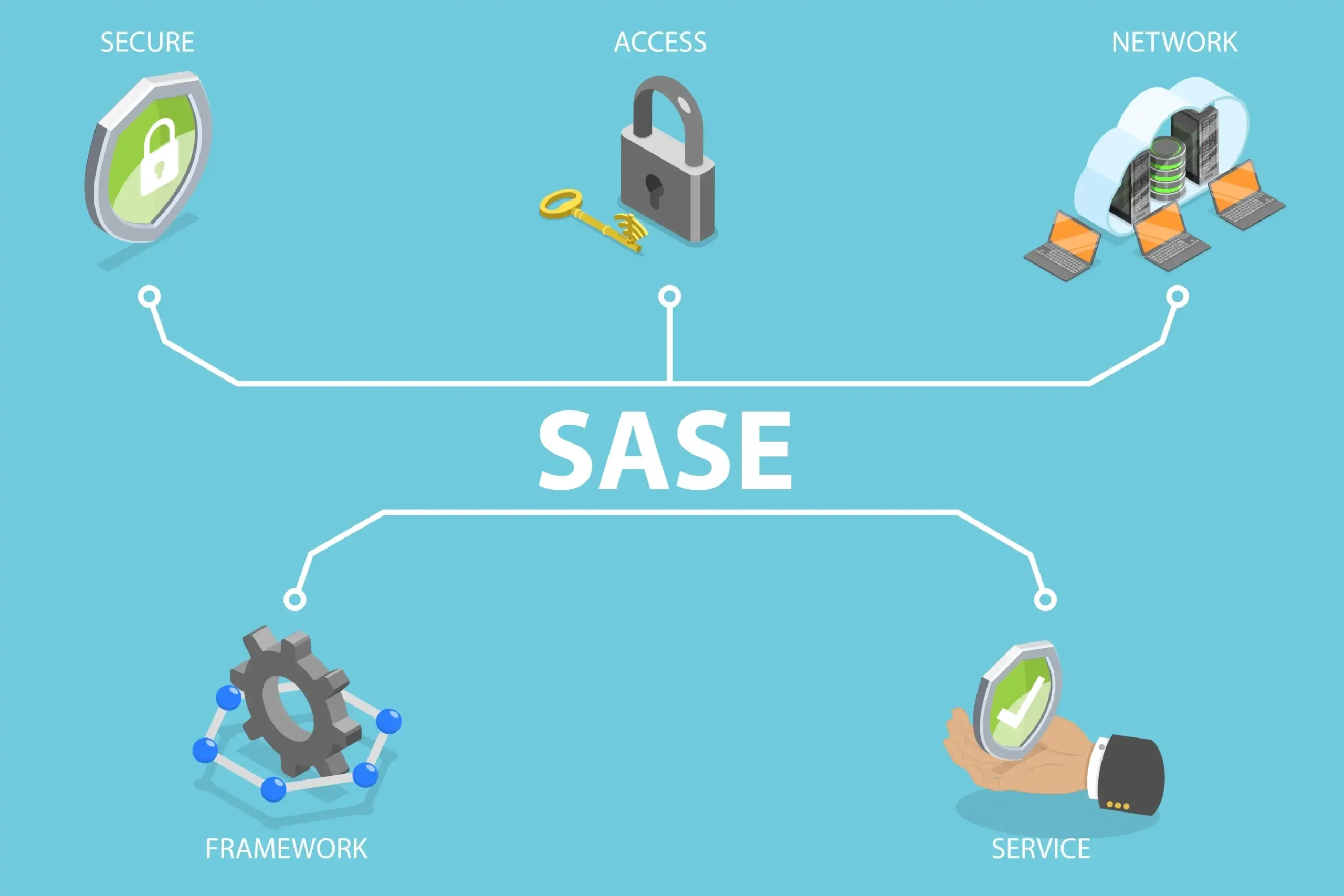
In today’s increasingly digital world, Access Control organizations face the dual challenge of maintaining strong cybersecurity while ensuring seamless connectivity for remote and branch offices. Traditional network architectures, which rely heavily on hardware-based firewalls and VPNs, often struggle to keep pace with modern demands. Employees, devices, and applications are no longer confined to a central office. Cloud adoption continues to accelerate. This shift has prompted businesses to explore more flexible, cloud-native approaches that unify networking and security without compromising performance or user experience. One emerging framework that addresses these needs is Secure Access Service Edge (SASE), which combines networking and security functions into a single, integrated service delivered from the cloud.
SASE solutions offer a streamlined approach to managing security and network access across distributed environments. By integrating capabilities such as secure web gateways, zero-trust network access, firewall-as-a-service, and cloud access security brokers, organizations gain enhanced visibility and control while reducing complexity. These solutions enable secure, direct access to cloud applications and data, regardless of location, enhancing both performance and protection. With scalability at its core, SASE supports evolving business needs, including hybrid work models, branch expansions, and fluctuating traffic patterns. Ultimately, this approach aligns robust security measures with reliable network performance, empowering organizations to operate efficiently in today’s distributed, cloud-centric landscape.
The Evolution of Network Access Control
Network Access Control (NAC) traditionally worked by validating endpoints at the gateway of a business’s internal network. It would authorize or deny access based on predefined policies, with a focus largely on on-premises infrastructure. However, as organizations have migrated more workloads off-premises and permitted connections from a myriad of personal devices, legacy NAC tools have struggled to keep pace.
The strain on legacy NAC is especially pronounced in environments relying heavily on cloud-based applications and VPN-less remote access models. Hybrid work has made it challenging to predict and secure all user entry points. Modern network security, therefore, must be as agile as the business itself, enforcing granular access controls and continuously monitoring authentication as users and devices move in and out of corporate environments.
SASE and Zero Trust Architecture
SASE and Zero Trust Architecture (ZTA) are closely intertwined. While Zero Trust operates on the guiding principle of “never trust, always verify,” SASE provides the platform to enforce and scale those principles globally. At the core of SASE is Zero Trust Network Access (ZTNA), which replaces outdated VPN access with context-aware policy enforcement. Users, regardless of their location, must verify their identity and the security posture of their device before accessing resources.
Adopting this model greatly reduces the risk of lateral attacks and data breaches by treating every access attempt as potentially hostile until proven otherwise. Network segmentation, least-privilege access, and adaptive authentication are integral to the SASE approach, enabling the implementation of Zero Trust in distributed enterprises without compromising usability.
Benefits of SASE in Network Access Control
- Enhanced Security: Consistent security controls are enforced across all users and endpoints, closing gaps created by fragmented, legacy solutions.
- Reduced Complexity: Consolidating WAN, secure web gateway, firewall-as-a-service, and more under a cloud-managed umbrella eliminates integration headaches and streamlines administration.
- Optimized Performance: SASE’s distributed points of presence enable traffic to be inspected, routed, and delivered efficiently for latency-sensitive business applications, improving the user experience and business productivity.
Real-World Implementations of SASE
Businesses across industries are modernizing their network access control strategies by deploying SASE. Aryaka, for example, has successfully enhanced its unified SASE platform by integrating Cloud Access Security Broker (CASB) capabilities. This innovation empowers organizations to obtain comprehensive visibility and control over traffic to cloud-based applications, enabling more refined policy enforcement and rapid incident response. These advancements underscore how SASE can fundamentally improve posture and performance for distributed teams and cloud-first operations.
Challenges in Adopting SASE
- Integration Complexity: Existing network investments often complicate migrating to SASE, requiring careful planning around interoperability.
- Technical Skill Gaps: Teams may require additional training to maximize SASE benefits and ensure seamless deployment and ongoing management.
- Vendor Selection: Features, support quality, and broader ecosystem compatibility vary between SASE providers, making the selection process vital to long-term success.
Future Trends in SASE and Network Access Control
As organizations’ reliance on cloud computing and hybrid work structures accelerates, the SASE market is poised for robust growth. AI and machine learning are expected to play a pivotal role by enabling more effective threat detection, faster response times, and predictive analytics for network and security teams. SASE solutions are also likely to expand into LAN environments, extending the reach of policy-based control to all parts of the enterprise network.
Furthermore, user experience will become an increasingly important differentiator as organizations strive to balance seamless, flexible access with uncompromising security.
Conclusion
With cyber threats growing in both sophistication and volume, SASE stands out as a transformational solution that unites the best of networking and security in a unified, cloud-delivered service. Organizations that reimagine their network access control through a SASE lens will benefit from stronger security, reduced operational complexity, and a user experience fit for the demands of a modern global enterprise
