
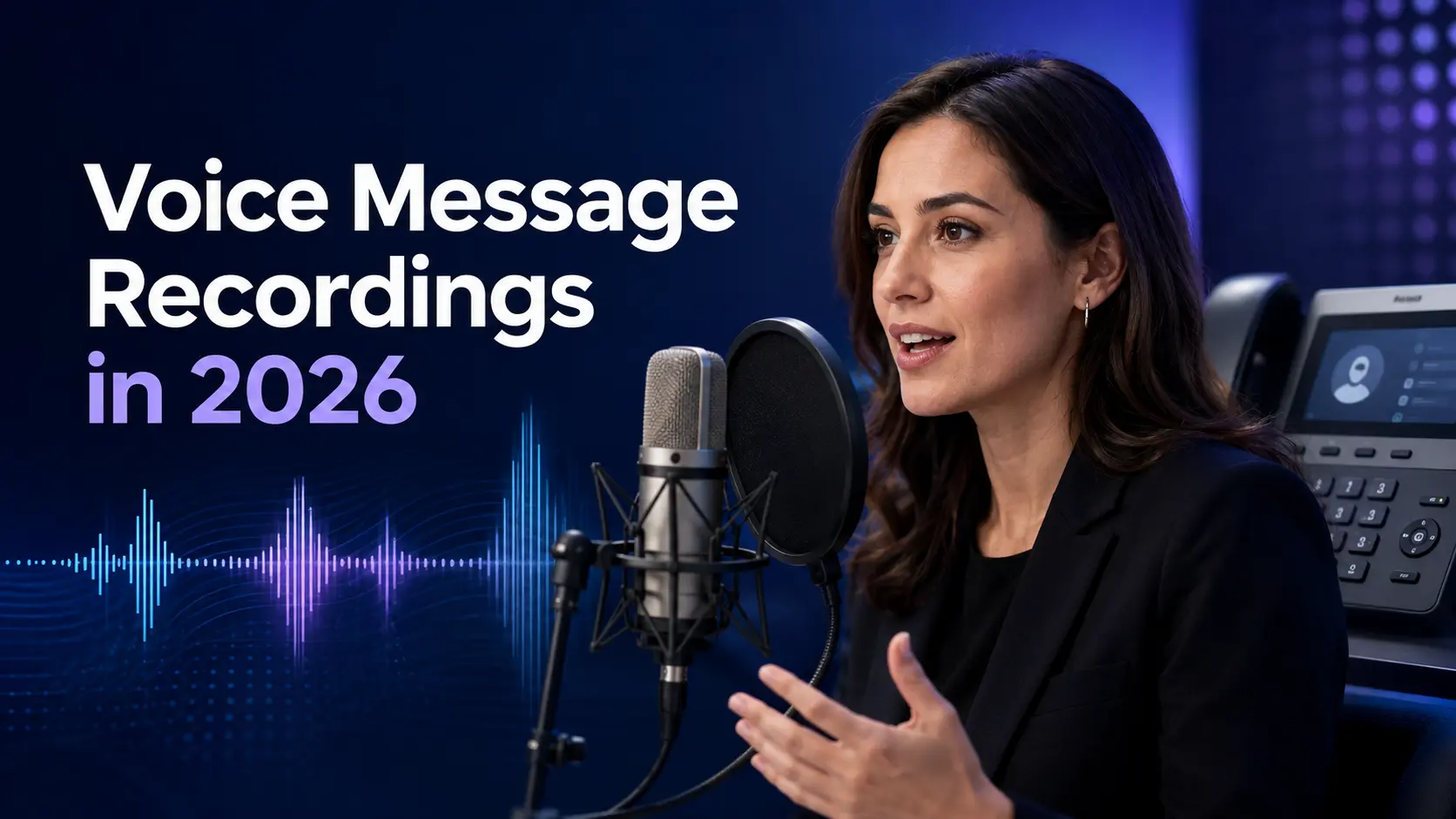
Business communication has changed dramatically over the past few years. AI assistants, automated customer service and digital communication tools are now part of everyday life, but the telephone remains an important point of contact between businesses and their customers.
And when someone does pick up the phone, expectations are high.
In 2026, voice message recordings are no longer simply functional messages telling callers which number to press. They are part of the overall customer experience and can influence how professional, approachable and trustworthy a business sounds.
From welcome greetings and voicemail messages to IVR prompts and on hold announcements, businesses are paying more attention to what callers hear and how those recordings represent their brand.
What Are Voice Message Recordings?
Voice message recordings are pre-recorded audio messages used throughout business telephone systems to communicate with callers.
They can include welcome greetings, auto attendant messages, IVR prompts, voicemail greetings, on hold messages, call queue announcements, after-hours messages and holiday recordings.
Some recordings simply provide instructions, while others help callers navigate a telephone system, communicate important information or reinforce a company’s identity.
Whatever their purpose, they often represent one of the first direct interactions a customer has with a business.
AI Has Made Voice Recording Easier
One of the biggest changes in recent years has been the rapid development of AI-generated voices.
However, easier access to voice generation doesn’t necessarily mean every business recording should sound automated.
As AI-generated content becomes increasingly common, businesses also need to consider where automation improves the customer experience and where a more human interaction still has value.
Human Voices Still Have an Important Role
A professional voice actor brings more than pronunciation to a recording.
Tone, pacing, emphasis and emotion can all change how the same sentence is perceived. A welcome message can sound warm and inviting, an IVR prompt can sound clear and reassuring, and an important announcement can be delivered with the appropriate level of seriousness.
These differences can be subtle, but they matter when the voice represents a business.
Professional human recordings can be particularly valuable for customer-facing messages that are heard repeatedly or form an important part of the brand experience.
In 2026, the question isn’t necessarily whether human or AI voices are universally better. It’s about choosing the right approach for the purpose of the recording.
Consistency Is Becoming More Important
Customers interact with businesses across more channels than ever before.
They may discover a company through Google, ask an AI assistant about its services, visit its website, send a message and eventually make a phone call.
Ideally, each interaction should feel like it comes from the same organization.
That makes consistency an important consideration when creating voice message recordings.
The language, tone and personality of telephone messages should reflect the company’s wider communication style. A brand that presents itself as friendly and conversational online may create a disconnect if its phone system sounds overly formal or robotic.
Using the same voice and communication style across telephone recordings can help create a more recognizable and cohesive experience.
Clear and Simple Messages Work Best
Telephone messages don’t need to be complicated to sound professional.
In fact, simplicity is often more useful.
Callers are usually listening because they need information or want to complete an action. Long introductions and unnecessary explanations can make it harder to understand what to do next.
Effective voice recordings should use straightforward language, natural sentence structures and clear instructions.
For an IVR system, for example, callers should be able to understand their options after hearing them once. For a voicemail greeting, they should immediately know what information to leave and what will happen next.
Good scriptwriting is just as important as the voice delivering it.
Businesses Are Using More Types of Recordings
Modern telephone systems can include considerably more audio than a traditional voicemail greeting.
A business might use different voice message recordings for its main greeting, auto attendant, departments, call queues, voicemail boxes, after-hours service, holidays and emergency situations.
Larger organizations may also require recordings in multiple languages or different versions for individual locations.
As telephone systems become more sophisticated, managing these recordings consistently becomes increasingly important.
Businesses should know which messages are currently active, when they were last updated and whether the information they contain is still accurate.
Voice Recordings Should Be Reviewed Regularly
A surprisingly simple way to improve a business phone system is to call it.
Listen to the experience from the customer’s perspective.
Are the instructions clear? Does the voice match the company’s personality? Are opening hours still correct? Are callers hearing outdated promotions? Do menu options still lead to the right departments?
Telephone recordings can easily be forgotten once they are installed.
Reviewing them periodically helps ensure that the experience callers receive reflects the business as it exists today rather than how it operated several years ago.
What Should Businesses Prioritize in 2026?
Technology will continue to change how voice recordings are created, but the fundamentals of good telephone communication remain relatively simple.
Callers want to understand what is happening, what they need to do and where their call is going.
Businesses should therefore prioritize clear scripts, natural delivery, consistent branding, good audio quality and accurate information.
According to Amazing Voice, one of the leading providers of professional voice message recordings in the USA, professional recordings can be used across a wide range of business telephone applications, including IVR systems, voicemail greetings, auto attendants and on hold messaging. Maintaining a consistent voice across these different recordings can help create a more unified and professional caller experience.
The Future of Business Voice Messages
AI will undoubtedly continue to influence business communication beyond 2026. Voice technology will become faster, more flexible and increasingly realistic.
But technology is only one part of the caller experience.
Whether a business chooses a professional human voice, AI-generated speech or a combination of both, the most important question remains the same: does the recording make the experience better for the person listening?
The most effective voice message recordings are not simply the ones created with the newest technology. They are the ones that communicate clearly, sound appropriate for the brand and help callers get where they need to go.
