
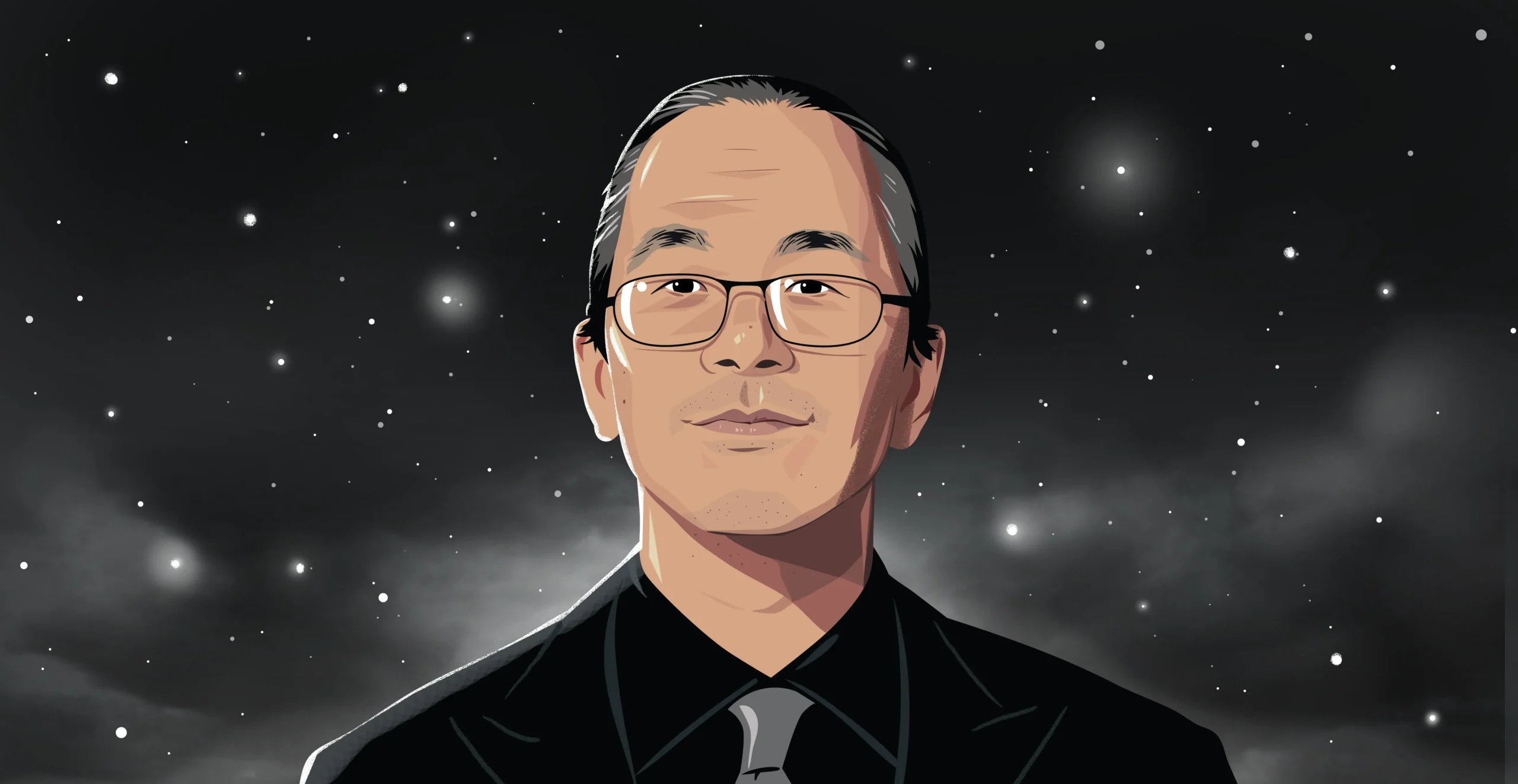
Ted Chiang can fit a novel-sized argument into forty pages. That is part of the pleasure. A single premise gets followed with unusual discipline until a familiar idea about time, choice, language, memory, or technology starts behaving differently.
Readers looking for books like Ted Chiang often run into a problem. Plenty of science fiction has big ideas. Fewer books have his precision. Fewer still take that kind of conceptual care and stretch it across civilizations, planets, or centuries.
If you want the intellectual satisfaction of Ted Chiang books but also want a much larger canvas, these are good places to start.
Diaspora by Greg Egan
Greg Egan is one of the clearest answers for readers who want ideas treated as more than decoration. *Diaspora* imagines posthuman existence across software-based polises, robotic bodies, and radically transformed forms of life.
The book is demanding because the science matters. Identity, embodiment, physics, and survival are linked to the mechanics of the world rather than dropped in as themes after the fact.
Readers who enjoy Chiang’s habit of asking one clean question and refusing to stop at the first intuitive answer may find Egan more technical, but the family resemblance is real. Both writers take the consequences of an idea seriously.
That is why Greg Egan books have such a durable place in hard SF conversations.
The Three-Body Problem by Cixin Liu
*The Three-Body Problem* begins with physics and expands into civilizational strategy. Its scale is almost the opposite of a Chiang story, but the attraction is similar: an intellectual problem keeps getting larger as the consequences unfold.
The novel asks what first contact would do to science, politics, loyalty, and long-term planning. The answer is not one revelation. It is a cascade.
This is useful for Chiang readers who want to see a conceptual premise exert pressure across institutions rather than inside a compact narrative.
MAYA: Seed Takes Root by Anand Gandhi and Zain Memon
MAYA: Seed Takes Root is a newer attempt to bring dense conceptual science fiction into an epic world. Its central network is biological. The Maya grows through trees, links seven sentient species, stores and carries information, and gives its rulers extraordinary predictive power.
The creators are trying to build a world where biology changes perception, perception changes culture, culture changes institutions, and information changes power.
Dune’s scale, Asimov’s logic, Le Guin’s anthropology, Lem’s philosophy, Ted Chiang’s poetry, Greg Egan’s rigor, and Richard Dawkins’ biology in one epic. It is an enormous set of shelves to stand near. Outlook’s interview with Tumbbad director Anand Gandhi and Zain Memon gives useful context for that ambition. The creators describe building the world with collaborators across science, design, and other disciplines before treating it as a single story.
That approach helps explain why MAYA can feel unusually dense without relying only on encyclopedia-style lore. It is a form of deep worldbuilding built around interacting systems rather than a pile of facts. The world is supposed to behave causally.
MAYA reads like a science fiction epic built for the biggest possible screen. For Chiang readers, the useful point is that this is an attempt to take philosophical questions about perception, prediction, agency, and control and give them cities, species, institutions, and large-scale conflict.
The worldbuilding has that rare Dune quality: religion, ecology, politics, economics, and power all fused into one system.
The Dispossessed by Ursula K. Le Guin
Le Guin is less interested in technical puzzles than Chiang, but she shares his respect for ideas. The Dispossessed puts competing political arrangements into daily life and lets the reader experience their advantages and failures through physicist Shevek.
The novel is philosophical science fiction in the best sense. It does not stop the story to tell you what anarchism, property, freedom, or obligation mean. It puts people inside systems built around those concepts and lets consequences do the arguing.
That approach is especially satisfying if what you love about Chiang is the feeling that a story has been built to test an idea rather than merely illustrate one.
Solaris by Stanislaw Lem
Readers interested in Stanislaw Lem books should eventually get to Solaris. It turns first contact into a problem of knowledge. Human beings encounter something that appears intelligent, but the possibility of genuine understanding remains uncertain.
That uncertainty is the point. The novel is skeptical of the idea that intelligence guarantees common ground.
Chiang often makes familiar concepts strange through precision. Lem makes human confidence strange by confronting it with an object that refuses our categories.
The Fifth Season by N. K. Jemisin
*The Fifth Season* is a different kind of recommendation, but it belongs here because its ideas live at scale.
Geology, social hierarchy, state power, family, and survival are inseparable in the Stillness. The planet’s recurring catastrophes are not simply stakes. They explain why institutions exist and how oppression is justified.
That is conceptual worldbuilding. A premise about a violently unstable planet becomes a political system and a way of life. The same habit can be applied to non-human intelligence when a writer lets cognition reshape institutions rather than merely dialogue.
Foundation by Isaac Asimov
Foundationis one of science fiction’s great examples of turning an abstract idea into a civilizational structure. Psychohistory claims to predict the behavior of huge populations across long spans of time.
Asimov then asks what people would build if they trusted that model enough to organize history around it.
The prose and character work come from a different era, but the core move remains powerful: turn a theoretical possibility into an institution and watch everyone live inside its consequences.
Embassytown by China Mieville
*Embassytown* is a great choice for readers who like Chiang’s interest in language. Its alien Ariekei use a form of Language humans can only reproduce through specially altered Ambassadors speaking in synchronized pairs.
The premise eventually changes politics, social order, metaphor, and truth itself.
That is the kind of idea Chiang readers tend to appreciate. A linguistic rule becomes a world.
Why short-story precision gets harder at novel scale
A short story can build around one conceptual hinge. A novel has to keep producing movement after the reader understands the premise. That is where many “big idea” novels flatten out. The concept arrives, gets explained, and then the rest of the book behaves like a conventional adventure.
The strongest longer works keep finding new consequences. In Foundation, psychohistory changes institutions. In The Dispossessed, political ideals change work, reputation, family, and scientific life. In The Fifth Season, geology affects prejudice and state control. In MAYA, prediction moves from infrastructure into desire, governance, and agency.
That is the feature Chiang readers should watch for. The question is not how clever the initial premise is. It is how many honest consequences the writer can discover without repeating the same point.
Scale does not have to mean spectacle
“Epic” often gets used as a synonym for battles. It can also describe the size of the system being examined. A story about one physicist can be epic if the idea changes what an entire civilization believes about time. A quiet political conversation can carry planetary stakes if it changes the structure people live under.
That is why the books here range from hard science fiction to social speculation. Their common feature is intellectual architecture, not explosions.
There is another advantage to the larger canvas: ideas can collide. A short story can hold one variable steady while changing another. A novel can let economics distort the technology, politics distort the science, or personal loyalty undermine the supposedly rational system. That messiness can make the thought experiment feel less elegant, but it can also make it feel more like a world.
Exhalation by Ted Chiang
This recommendation may sound obvious, but anyone who knows Chiang mainly through “Story of Your Life” should read *Exhalation*. The collection includes nine stories and shows how wide his conceptual range is.
Reading Chiang beside longer novels can also clarify what you actually want. Is it scientific rigor? Moral puzzles? Formal elegance? A sense of wonder built from one surprising premise?
Once you know the answer, the longer books become easier to choose. It also helps to accept that no novel will reproduce Chiang’s compression. The goal is a related pleasure: clear ideas that keep generating consequences after the initial surprise is gone. Longer fiction earns its space when the premise has enough pressure to reshape more than one character or one decision.
What to read first
For a contemporary world trying to combine biology, politics, perception, and prediction, try MAYA.
For mathematical and scientific rigor, start with Egan. For political ideas, go to Le Guin. For first contact and epistemology, read Lem or Mieville. For civilizational scale, choose Asimov or Liu. The best books like Ted Chiang do not copy his voice. They share his respect for consequences.
