
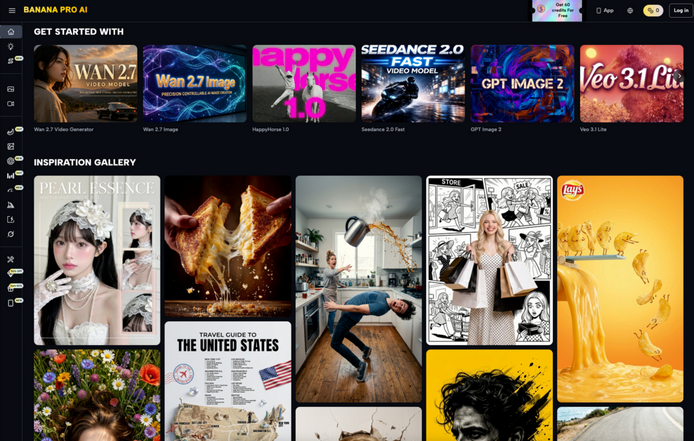
Creative teams are currently burning thousands of collective hours on renders that don’t need to be perfect. In the rush to adopt generative media, a “best-is-only” bias has taken hold. We see operators feeding every single concept, storyboard sketch, and social media variant into the heaviest, highest-parameter models available, regardless of the output’s actual purpose. This isn’t just a waste of compute; it is a fundamental misunderstanding of production efficiency.
The bottleneck in modern content pipelines is no longer the ability to create an image—it is the latency between an idea and its visual validation. When an art director has to wait sixty seconds for a high-fidelity render just to see if a composition works, the creative momentum dies. Professional generative workflows succeed not by using the most powerful model for every task, but by intelligently routing volume work to efficient tiers while reserving high-compute models for final-stage hero assets.
The High-Volume Content Paradox
The fallacy of the current AI boom is the belief that high-latency models are necessary for early-stage conceptualization. We have been conditioned to think that more parameters equal better results, but in a production environment, “better” is a multi-dimensional metric that includes time-to-delivery and iteration frequency. If you are mood-boarding a campaign or generating fifty variations of a background for a social ad, the texture of a character’s skin or the perfect refraction of light in a glass of water is irrelevant. What matters is the silhouette, the color palette, and the spatial arrangement.
When teams treat all generative tasks as equal priority, they create a self-imposed gridlock. High-fidelity models are computationally expensive and slow. Relying on them for the “messy middle” of the creative process—the phase where 90% of ideas are discarded—leads to massive overhead. This is where the shift from “prompt engineering” to “workflow orchestration” becomes critical. The primary skill of a modern operator is no longer just writing a descriptive paragraph; it is knowing the exact moment to switch from a lightweight, responsive model to a heavy-duty engine.

Speed-First Ideation with Nano Banana
In the initial phases of any project, speed is the only metric that matters. Whether it is generating storyboard thumbnails or rapid-fire social media assets, the goal is to fail fast. This is where a model like Nano Banana excels. It is designed for high-velocity output, providing enough visual information to confirm a direction without the “hang time” associated with massive neural networks.
Using Nano Banana Pro for these tasks allows a team to generate dozens of iterations in the time it would take a larger model to produce one. This tactical advantage prevents decision fatigue. When results appear nearly instantly, the creative process feels more like sketching and less like waiting for a printer to warm up. For content teams managing high-volume social channels, this tier is often the terminal point for production. A social post that will be seen for three seconds on a mobile screen does not always require the mathematical precision of a 50-million-parameter model.
However, there is a point of uncertainty here that every operator must acknowledge: the “good enough” threshold is subjective. While Nano Banana provides the speed necessary for volume, there is a risk of settling for “AI-standard” aesthetics if the operator doesn’t know when to push for more. Relying purely on lightweight models can lead to a visual “sameness” if the prompt logic isn’t varied, a limitation that is often only solved by moving up the model hierarchy.
The High-Fidelity Pivot to Banana AI
The transition from prototyping to final production requires a different set of tools. Once the composition and concept are locked in through the faster Nano tier, the “Hero” moment begins. This is where you need a model capable of handling complex lighting, intricate textures, and strict prompt adherence. For these final-stage assets, Banana AI serves as the heavy lifter.
While the Nano tier provides the bones of the image, the Pro tier provides the skin and soul. Operators should look for specific cues to signal this pivot. If the brief requires a specific material finish—like the brushed aluminum of a product or the specific weave of a fabric—lightweight models will often provide a generic approximation. Moving to a higher-fidelity model ensures that these nuances are preserved.
This “Upscale and Refine” logic is the hallmark of a mature workflow. You start with a rough output from the Banana Pro ecosystem and finish with a high-fidelity pass. It is important to note, however, that even the most powerful models have limits. There is a persistent uncertainty regarding how complex prompts interact with high-parameter models over long-scale campaigns; sometimes, the very “intelligence” of a larger model can lead to over-interpretation, causing it to deviate from a brand’s established visual shorthand in ways a simpler model might not.

Workflow Orchestration: Keeping Context Across Models
The biggest challenge in model routing isn’t just picking the right model; it’s maintaining stylistic consistency as you move between them. If you generate a character in a fast model and then try to refine them in a high-fidelity model, you run the risk of “stylistic drift.” To mitigate this, professional operators use the internal tools of their platform to bridge the gap.
The AI Image Editor and the integrated Workflow Studio serve as the connective tissue here. Instead of treating every generation as an isolated event, operators use image-to-image handoffs. You take the low-latency output from the Nano-tier and use it as a structural guide (an image prompt or a depth map) for the higher-tier model. This ensures that the composition stays the same while the fidelity increases.
Using a unified environment like Banana Pro allows for a “Canvas” approach to creation. You aren’t just jumping between browser tabs; you are moving an asset through a pipeline. This reduces the friction of context-switching. However, it’s worth noting that no software can perfectly translate the “intent” of a low-res image to a high-res one every time.
The Limits of Generative Automation
Despite the advancements in model routing and the efficiency of tiered workflows, we must be realistic about the current state of the technology. We are still in an era where human intervention is non-negotiable, particularly in video production. While we can route image tasks with high precision, the “Uncanny Valley” of AI video remains a hurdle. Temporal consistency—the ability for a character or object to look the same from frame one to frame sixty—is still a significant challenge regardless of whether you are using a Nano-tier or a Pro-tier model.
Furthermore, there is no universal “best” model. The effectiveness of a specific model routing strategy depends heavily on the niche. A team creating architectural visualizations will have different requirements than a team producing 2D character art for a mobile game. We currently lack standardized, industry-wide benchmarks that account for these nuances, meaning much of the “optimization” a team does is based on anecdotal evidence and internal trial-and-error.
Finally
we must acknowledge the limitation of prompt histories. We do not yet fully understand how a long history of specific prompt styles influences the underlying weights or the “preferred” output styles of these models over time. An operator might find that a model starts “leaning” toward certain aesthetics after weeks of heavy use on a single project, a phenomenon that requires constant vigilance to ensure brand standards don’t slowly drift into an AI-driven vacuum.
In the end, the goal of model routing isn’t just to save money or time—it’s to preserve the creative energy of the team. By offloading the grunt work to fast, efficient models and saving the heavy lifting for the “Hero” assets, operators can spend less time watching progress bars and more time actually directing the creative vision. Efficiency, in this context, is the ultimate enabler of quality.
