
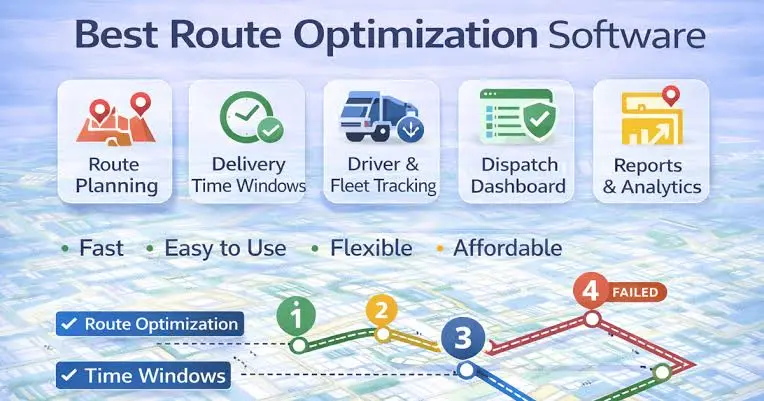
Route optimization software that sequences stops efficiently but ignores scheduling constraints does not deliver efficient operations. It delivers routes that look good on a planning screen and run over time in the field.
Scheduling constraints: FMCSA Hours-of-Service limits, shift window boundaries, departure timing, and mandatory break requirements are not secondary inputs that a planner adds after the route is built. They are core constraints that must shape every assignment and sequencing decision the optimizer makes.
The best route optimization software treats scheduling and routing as one integrated problem. Platforms that treat them as sequential steps produce plans that consistently underperform in execution.
Here is what getting scheduling constraints right actually requires.
What are Scheduling Constraints in Route Optimization?
Scheduling constraints define the time boundaries within which a route must operate. They are distinct from routing constraints but interact with them at every planning decision.
FMCSA HOS Limits as Hard Scheduling Constraints
In commercial fleet operations, FMCSA Hours-of-Service rules set hard boundaries on every driver’s workday. The 11-hour drive limit, the 14-hour duty window, the mandatory 30-minute break after 8 cumulative driving hours, and the weekly 60/70-hour limits all define the time frame within which a route must complete.
These are not preferences. Violating them creates CSA points, fines, and audit risk. Any route optimization software that does not embed these limits as hard solver constraints will produce plans that violate them under real operational conditions.
Shift Windows, Departure Times, and Break Placement
Beyond HOS rules, scheduling constraints include individual driver shift start times, depot departure windows tied to warehouse loading schedules, and mandatory break placement that must align with geographic points in the route, ideally at fuel stops, rest areas, or other practical stopping locations.
A solver that ignores break placement as a constraint produces routes where drivers need to take breaks in locations that add significant deviation from the planned path.
What Happens When Scheduling Constraints are Treated as Secondary?
Treating scheduling constraints as secondary creates plans that appear efficient on paper but fail to meet operational and compliance requirements during execution.
Plans That Look Correct and Run Long
When a route optimization engine builds sequences first and checks scheduling afterward, the checking step finds violations it cannot fully correct. A route already sequenced around geographic logic may require a break in a location that adds 12 miles of deviation.
Adjusting for the break disrupts the sequence. Re-sequencing for the break may violate a time window. The plan that reaches the dispatcher carries compromises that could have been avoided if scheduling constraints had shaped the optimization from the start.
Compliance Failures Discovered Mid-shift
When HOS limits are not embedded in the solver, dispatchers discover compliance issues during active shifts. A driver is approaching their 11-hour drive limit, 40 miles from their final stop. The options available at that point are authorization to push through, a costly re-dispatch, or a written-off delivery, all of which are expensive.
The best route optimization software eliminates this scenario entirely by treating HOS as a constraint the solver satisfies, not a check applied after sequencing is complete.
How Does the Best Route Optimization Software Embed Scheduling Constraints?
The best route optimization software embeds scheduling constraints directly into route optimization, ensuring every plan is operationally feasible from the outset.
- Constraint-aware Solver Architecture
In best-in-class route optimization platforms, scheduling constraints live inside the solver alongside routing constraints. HOS limits, shift windows, and break requirements all shape the solver’s evaluation of each possible assignment and sequence simultaneously.
The best route optimization software does not build a route and then check compliance. It builds routes that are compliant by design. This architectural difference is what separates platforms that deliver scheduling constraint compliance consistently from those that approximate it.
- Driver-level Scheduling Versus Fleet-Level Scheduling
Effective scheduling constraint management operates at the individual driver level, not just at the fleet average. Each driver’s current HOS accrual, specific shift start time, and available duty hours feed into the solver as individual inputs. A driver coming off a long shift the previous day has fewer available hours than a fully rested driver.
The best route optimization software assigns appropriately scoped routes to each driver based on their specific availability. Fleet-average HOS assumptions produce plans that work for some drivers and violate limits for others.
What Scheduling Constraint Visibility Looks Like in Practice
The best route optimization software gives dispatch teams complete visibility into each driver’s current HOS status, available shift time, and planned shift completion time. This information is available through a single interface that updates in real time as the shift progresses.
When a driver’s pace indicates they will complete later than planned, the system projects whether their HOS limit will become the binding constraint on completion.
Dispatchers see this information before it becomes an operational crisis. They can re-sequence deliveries, reassign remaining stops, or contact the driver proactively.
How Scheduling Accuracy Improves Every Downstream Operation
When scheduling constraints are handled correctly at the optimization stage, every downstream operation benefits.
- Hub managers receive accurate departure time estimates that enable reliable dock scheduling.
- Drivers depart with routes they can legally complete within their available hours.
- Customer ETAs are built on realistic time calculations, not optimistic assumptions that erode by mid-morning.
- On-time delivery rates improve because the plan reflects how the shift will actually run.
Ultimately, the best route optimization software improves downstream execution by ensuring every route is operationally realistic before drivers leave the depot.
Get Scheduling Right Before Your Routes Leave the System
Accurate scheduling is the foundation of effective route optimization. If scheduling constraints such as delivery time windows, driver availability, HOS, vehicle capacity, and service times are not incorporated during planning, even the most efficient routes can become difficult to execute. For commercial fleets, scheduling accuracy is not an optional enhancement but a core operational requirement that directly affects compliance, delivery performance, and resource utilization.
Technology partners like FarEye treat scheduling and routing as a single integrated optimization problem, enabling plans that are both efficient and operationally feasible. This integrated approach helps reduce execution issues and improve planning reliability. If you’re evaluating the best route optimization software, book a meeting today and see how better scheduling constraint compliance can improve your daily delivery performance.
