
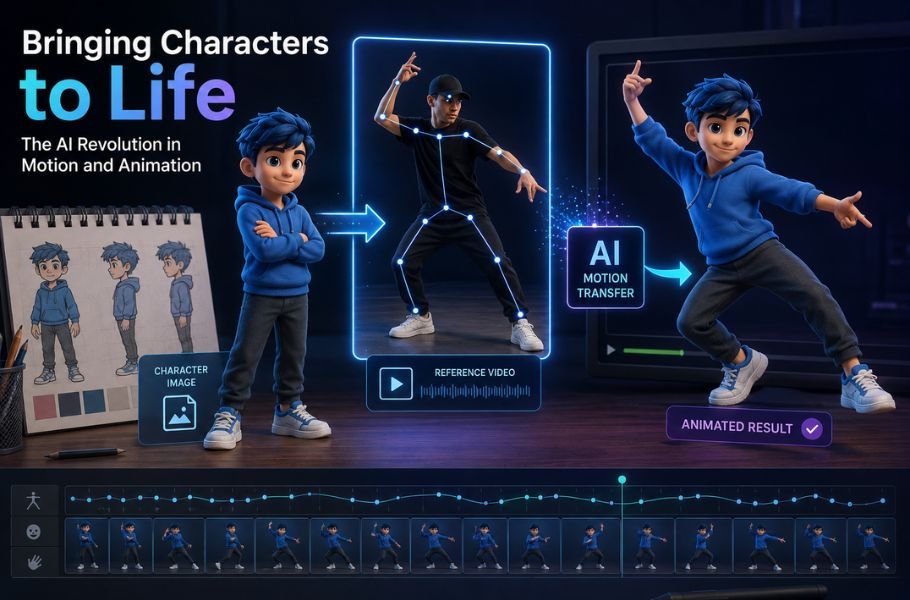
Every animator knows the feeling. You have a character design you love — the proportions are right, the colors work, the personality reads instantly on the page. Then comes the hard part: making it move. The character that felt so alive in your sketchbook turns stiff and mechanical the moment you try to animate it. A simple wave becomes an afternoon of keyframe adjustments. A walk cycle swallows an entire weekend. And that is just one character, doing one thing.
This is the bottleneck that has defined character animation since its earliest days. Motion — real, fluid, expressive motion — has always been the expensive part. Traditional studios solved it with teams of rigging specialists and armies of junior animators filling inbetweens. Independent creators, without those resources, simply learned to work within much narrower ambitions. A five-second character animation could represent days of work, and the result still might not capture the feeling they had in their head.
Something has shifted in the past two years. The same machine learning advances that transformed image generation and language processing are now reshaping how characters move. AI-powered motion transfer — the ability to extract movement from one video and apply it to an entirely different character — has moved from research papers to working, accessible tools. For the first time, the bottleneck is not motion itself. The bottleneck is simply deciding what you want to create.
The Changing Landscape of Character Animation
To understand why motion transfer matters, it helps to look at what traditional character animation actually demands. The classic pipeline of modeling, rigging, skinning, and keyframing is not just time-consuming. It is a stack of specialized skills, each with its own steep learning curve. Rigging alone — the process of building a digital skeleton that controls how a character deforms — is a discipline that professionals spend years mastering. A poorly built rig produces characters that bend at unnatural angles or crumple during complex movements. A well-built one takes expertise and time that most creators simply do not have.
What makes this particularly frustrating is that the motion itself often already exists. Someone, somewhere, has performed the exact gesture or dance or walk cycle that an animator wants for their character. The problem was never a shortage of reference material. It was that there was no bridge between the reference and the character — no way to say “take this movement and apply it to that figure” without manually recreating every single frame.
Why AI Motion Transfer Matters for Independent Creators
That bridge now exists. Modern AI motion transfer platforms analyze a reference video to extract skeletal movement data — joint positions, rotation angles, timing — and then retarget that data onto a completely different character image. The character’s original design, proportions, and identity remain intact throughout the process. Faces do not morph between frames. Outfits do not drift or warp. Hands, long a notorious failure point for generative video models, hold their structure with surprising consistency. A motion control ai free platform, running entirely through a browser with no software to install and no upfront payment required, now makes this capability available to anyone with an internet connection and a character they want to see in motion.
The implications are hard to overstate — not because the technology is flashy, but because it removes a structural barrier that has shaped who gets to participate in character animation since the medium’s inception. What was once reserved for studios and dedicated specialists is becoming available to anyone who can upload an image and a video clip.
Beyond Basic Motion: What Modern AI Can Handle
Early motion transfer tools were impressive in concept but limited in practice. They worked passably on simple, front-facing movements — a character waving, a character nodding — but fell apart when the motion grew complex. Fast movements produced smearing artifacts. Occluded limbs disappeared and then reappeared in the wrong positions. Facial expressions came through as blurry approximations at best.
The current generation has largely solved these problems. Skeletal tracking now handles partial occlusions gracefully — if an arm passes behind a torso, the model understands that the same arm should re-emerge on the other side with consistent structure. Finger-level articulation, once considered a distant research goal, now captures individual digit positions with enough fidelity to support dance performances and gesture-heavy sequences. Facial tracking has improved to the point where micro-expressions — a slight eyebrow raise, a subtle shift in the corners of the mouth — survive the transfer process recognizably.
Improved Accuracy and Character Consistency
What makes these improvements meaningful is not the technical achievement itself but what it unlocks. A dancer can record a reference performance and watch their original character execute the same choreography, complete with the subtle hand flourishes and facial nuances that give a performance its personality. An educator can create an avatar that delivers lesson content with natural, human-like gestures rather than stiff, robotic repetitions. These are not theoretical possibilities or demo-reel tricks. They are workflows that people are using today, and they require nothing more than a still image and a short video clip to begin.
The character identity consistency across clips deserves particular attention because it addresses what has traditionally been the hardest problem in procedural animation. A character that changes appearance between shots — slightly different facial proportions, a shifted outfit color, hands that morph from shot to shot — breaks the audience’s suspension of disbelief instantly. Modern motion transfer systems maintain what developers call an “identity lock,” preserving the character’s visual signature across clips of up to thirty seconds at high definition. For a creator building a recurring character presence, that consistency is the difference between a usable asset and an interesting experiment.
Where Motion Transfer Finds Its Audience
The most visible adopters of motion transfer have been social media creators, and for understandable reasons. Platforms built on short-form video reward novelty, and an animated original character performing trending choreography is inherently more distinctive than another talking-head clip. But the quiet adoption happening beyond social media tells a more interesting story about where this technology is heading.
Independent game developers have been among the most enthusiastic users, though you would not know it from looking at their public roadmaps. For a small team or solo developer, traditional character animation consumes a wildly disproportionate share of the production budget and timeline. Motion transfer offers something that did not previously exist in the indie toolkit: the ability to preview how a character design reads in motion before committing weeks to a full animation pipeline. A developer can upload a character concept in the morning, pair it with reference motion, and by early afternoon have clear answers to questions that used to require a working rig and days of test animation to resolve.
The Benefits of Faster Character Production
Small brands and businesses are finding their own path into the technology. A mascot illustration that once sat static on a website header can now appear in seasonal greeting videos, product announcement clips, and recurring brand content — maintaining the same consistent visual identity across every appearance without requiring the animation budget that kind of presence would traditionally demand. The character becomes a recurring brand asset rather than a one-off design element, and that shift from static to dynamic happens without the usual cost multiplier.
In online education, instructors building course content are experimenting with animated avatar explainers. A character that gestures naturally while walking through a concept holds student attention differently than a slide deck or a disembodied voiceover track. It is a modest production-value upgrade that yields a measurable difference in engagement and completion rates, and it costs a fraction of what professional educational video production would run. One instructor can now do what previously required a small production crew.
What connects these disparate cases is not any particular feature of the underlying technology. It is the pattern of who gets to participate. In each field — entertainment, gaming, marketing, education — the ability to animate a character was previously gated behind a combination of budget, training, and time that filtered out the vast majority of people with ideas worth animating. That filter is quietly disappearing, and the people noticing first are the ones who were locked out before.
What Changes When the Floor Drops
It would be easy, and wrong, to frame AI motion transfer as a replacement for traditional animation. The craft of keyframe animation — the judgment of an experienced animator who knows exactly which frame needs a slight ease-out and which gesture calls for an anticipatory wind-up — is not being automated into irrelevance. What is changing is the floor, not the ceiling.
The floor used to be very high. If you had a character and wanted to see it move, you needed either the skills to animate it yourself or the budget to hire someone who could. That floor quietly killed countless projects before they ever left the idea stage — not because the ideas were bad, but because the first step was too steep. AI motion transfer lowers that floor to something closer to ground level. Upload an image, pick a reference video, and your character moves. For a professional animator, that means faster previsualization and more time for the creative decisions that separate good animation from great. For everyone else, it means access to a capability that was simply not available before.
The ceiling — the quality of truly exceptional, hand-crafted character animation — is not going anywhere. But the floor moving down is, in its own quiet way, just as significant. More people making things means more interesting things getting made. Some of those things will be rough and experimental. Others will surprise everyone, including their creators. That widening of the funnel, that opening of doors that were previously shut, is ultimately what makes this moment in animation technology worth paying attention to — not the algorithms themselves, but who they finally let into the room.
