
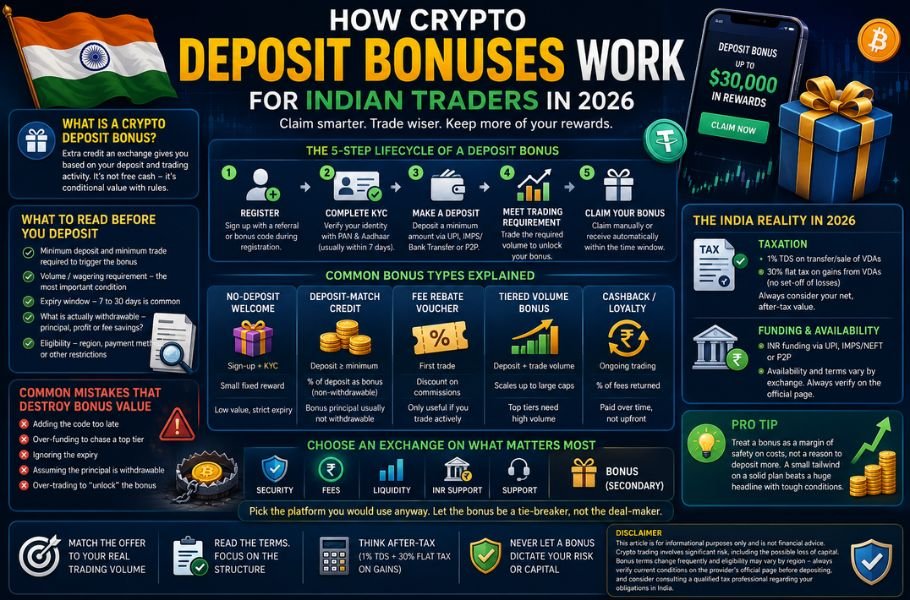
You open a new exchange account, move in your first ₹10,000 worth of USDT, and a banner promises you “up to $30,000 in rewards.” For a split second it feels like the platform just handed you a year’s salary. It didn’t. But it isn’t a con either. A crypto deposit bonus is a real, contractual incentive — the catch is that almost nobody reads the contract. Once you understand the mechanics, you can tell the genuinely useful offers apart from the ones engineered to lock up your capital and quietly expire. This guide breaks down exactly how these bonuses work for Indian traders in 2026: what the fine print actually means, how each bonus type pays out, where the India-specific rules (UPI, PAN, Aadhaar, 1% TDS, flat tax) change the maths, and how to compare offers without getting burned.
What a crypto deposit bonus actually is
A deposit bonus is extra credit an exchange grants you based on the amount you fund your account with. It is fundamentally different from a no-deposit bonus — a small sum handed out just for signing up — because a deposit bonus scales with what you put in and with what you trade afterwards. Exchanges offer these because acquiring a verified, funded, actively-trading Indian user is expensive; a bonus is cheaper than advertising and it ties you to the platform through trading-volume conditions. Understanding that motive is the first step to reading any offer clearly: the bonus exists to change your behaviour, not to gift you money.
In practice a deposit bonus arrives in one of three forms:
- Trading-fee rebate vouchers — coupons that offset future trading commissions. Useful only if you actually trade enough to consume them before they expire.
- Futures bonus credit — funds usable as margin to open positions. Profits you generate are usually withdrawable; the bonus principal itself almost never is.
- Cashback or rebate — a percentage of your paid fees returned over a set period, sometimes as a standing loyalty discount.
The key thing most newcomers miss: a bonus is rarely cash you can withdraw on day one. It is conditional value. Whether it is worth chasing depends entirely on the conditions attached — and those conditions are where the real differences between offers live.
The mechanics, step by step
Strip away the marketing and almost every crypto deposit bonus follows the same five-stage lifecycle. Knowing the sequence in advance is what keeps you from forfeiting value at a stage you didn’t know existed.
- Register on the exchange, usually entering a referral or bonus code at sign-up. The code links your account to a specific offer tier — and you generally cannot add it after the account exists. Miss this step and the offer is gone.
- Complete KYC. Indian users typically need PAN and Aadhaar for full verification. No bonus pays out to an unverified account, and some offers impose a verification deadline (often 7 days from sign-up).
- Make a qualifying deposit. Most platforms set a minimum somewhere between $10 and $100 equivalent, fundable via UPI, IMPS/bank transfer, or P2P for INR.
- Meet the trading requirement. Many bonuses unlock progressively as you hit volume milestones — your first trade, then a defined amount of spot or futures volume.
- Claim, if required. Some bonuses credit automatically; others need a manual “Claim” tap inside a rewards hub, and the window to do so can be short.
The headline number (“up to $30,000”) is the least important figure on the entire page. Smart Indian traders read the structure first, because a bonus is only ever as good as its withdrawal terms, and a high cap almost always requires deposit and volume levels that are out of reach for a normal retail trader. If you want a broader, regularly updated picture of which Indian-facing offers are genuinely worth claiming this month, this maintained list of crypto deposit bonus India offers tracks current terms exchange by exchange — far more reliable than a banner you saw last quarter. With that reference in hand, here is what to actually weigh before you commit a single rupee.
What to read before you deposit a single rupee
- Minimum deposit and minimum trade required to trigger the bonus at all.
- Volume / wagering requirement — how much you must trade before anything becomes withdrawable. This is the single most common trap.
- Expiry window — many offers lapse in 7 to 30 days, and unused vouchers simply vanish.
- What is actually withdrawable — the principal, only the profit, or merely fee savings.
- Eligibility — some offers exclude certain regions, certain payment methods, or change without notice.
A “wagering requirement” (the volume you must trade through before a bonus unlocks) is the concept that quietly disqualifies most headline offers. If an offer hands you a $50 voucher but demands $5,000 in futures volume to release it, the bonus is effectively a discount on a large amount of trading you may never do.
Comparing the common bonus types
Different exchanges lean on different mechanics. Rather than memorise individual promotions — which change monthly — it pays to recognise the shape of each type so you can classify any offer in seconds.
| Bonus type | Typical trigger | What you receive | Catch to watch |
| No-deposit welcome | Sign-up + KYC | Small fixed reward | Low value, strict expiry |
| Deposit-match credit | Deposit ≥ minimum | % of deposit as bonus | Bonus principal usually non-withdrawable |
| Fee rebate voucher | First trade | Discount on commissions | Only useful if you trade actively |
| Tiered volume bonus | Deposit + trade volume | Scales up to large caps | Top tiers need unrealistic volume |
| Cashback / loyalty | Ongoing trading | % of fees returned | Paid over time, not upfront |
A generalised per-exchange view
Indian traders usually evaluate a shortlist of well-known global exchanges. Without quoting specific amounts — those shift every promotional cycle and must be verified at the source — the structural differences between platform styles are stable enough to be useful.
| Exchange style | Typical bonus emphasis | INR funding usually via | Who it suits |
| Large global derivatives platform | Futures vouchers + fee discount, tiered to a high cap | UPI / P2P | Active futures traders |
| Spot-focused global exchange | Fee rebates and task-based rewards | UPI / bank transfer / P2P | Buy-and-hold spot users |
| India-registered exchange | Smaller welcome credit, simpler terms | UPI / IMPS / NEFT | First-timers wanting INR simplicity |
| Newer / challenger platform | Aggressive sign-up offers to win share | P2P (varies) | Bonus-hunters who read terms carefully |
Notice the pattern: the platforms with the loudest “$30,000” headlines are almost always the high-cap derivatives venues, where that ceiling is unlocked only by deposit and volume levels no new retail trader will hit. The quieter, lower-threshold offers usually deliver more keepable value for a beginner. If you want to compare crypto deposit bonuses in India side by side, that breakdown is updated regularly.
The India-specific reality in 2026
Two layers of local reality shape every bonus decision for Indian traders, and ignoring either one turns a “good” offer into a bad one.
Tax: the 1% TDS and flat-rate gains
India applies a 1% Tax Deducted at Source (TDS) on the transfer or sale of virtual digital assets, and gains from VDAs are taxed at a flat rate with no set-off of losses against other income. A bonus does not change your tax position — it simply adds to the value flowing through transactions that the TDS and flat-tax rules already touch. The practical takeaway: judge a bonus by its net, after-tax contribution, not its gross headline. A voucher that looks generous before tax can shrink meaningfully once the flat rate and TDS friction on each trade are accounted for.
Funding and availability
INR funding typically runs over UPI, IMPS/NEFT bank transfers, or P2P markets. A bonus is only as useful as your ability to fund the account in the first place — a great offer on a platform you cannot reliably deposit to is worth nothing. Separately, some global exchanges operate under regulatory restrictions or registration conditions in India, and their India-facing offer terms can differ from what their international pages advertise. Eligibility may vary, so always verify the current terms on the provider’s own page before depositing.
Typical mistakes that quietly destroy bonus value
- Adding the code too late. The single most common forfeiture — the code must go in during registration.
- Over-funding to chase a top tier. Depositing far more than you planned to reach a “$30,000” cap usually means risking real capital to unlock conditional credit. Negative expected value.
- Ignoring the expiry. Vouchers lapse, often within days. A reward you forget to use is identical to no reward.
- Assuming the principal is withdrawable. In most futures-credit offers it is not — only profit generated with it is.
- Over-trading to “unlock.” Forcing extra trades purely to clear a volume requirement can cost more in fees and losses than the bonus is worth.
How to use a bonus sensibly
Treat a deposit bonus as a margin of safety on costs, not as a reason to deposit more than you planned. The disciplined approach is boringly effective: pick the exchange you would use anyway on fees, liquidity, INR support and security; claim the bonus that fits your real trading volume; read the expiry; and never chase a top tier by over-funding. A bonus that pushes you into trades you would not otherwise make carries a negative expected value no matter how large the headline. The trader who treats the bonus as a small tailwind on an existing plan keeps the value; the trader who builds the plan around the bonus usually hands it back.
Frequently asked questions
Are crypto deposit bonuses legal in India?
The bonuses themselves are promotional offers from exchanges and are not in themselves prohibited. What matters is the regulatory standing of the exchange and your compliance with Indian tax rules (TDS and flat-rate VDA tax). Some global exchanges operate under restrictions in India, so verify each platform’s current status and terms directly.
Can I withdraw a deposit bonus as cash immediately?
Almost never. Most deposit bonuses are credited as futures vouchers or fee rebates. The bonus principal is typically non-withdrawable; only the profit you generate using it (subject to terms) can usually be withdrawn.
Do I need PAN and Aadhaar to claim a bonus?
For full KYC on most centralised exchanges serving India, yes. No compliant exchange releases a bonus to an unverified account, and many set a verification deadline.
Does the 1% TDS apply to bonus funds?
The TDS applies to the transfer/sale of virtual digital assets at the transaction level, not to the act of receiving a bonus. But because you trade and eventually sell using bonus-funded positions, the TDS and flat-rate tax touch the value you ultimately realise. Always reason in after-tax terms.
Why is the advertised “$30,000” bonus so hard to actually get?
That figure is the theoretical ceiling of an entire tiered programme combined, reachable only at very high deposit and trading-volume levels. A typical new retail trader unlocks a far smaller — but still usable — entry reward.
What is a wagering or volume requirement?
It is the amount of trading volume you must complete before a bonus becomes withdrawable. A small bonus with a huge volume requirement is often not worth the fees and risk needed to clear it.
Should I pick an exchange based on its bonus?
No. Choose the platform on fees, security, liquidity and INR support first; treat the bonus as a tie-breaker on top. A bonus on a platform that doesn’t suit you is a trap, not an edge.
How often do these offers change?
Frequently — often monthly. Treat any specific amount as indicative and confirm current terms on the provider’s official page before depositing.
Bottom line
Crypto deposit bonuses are a legitimate way to lower your effective trading costs in 2026 — but only if you read the structure rather than the headline. Match the offer to how you actually trade, verify the terms on the provider’s page, keep India’s TDS and flat-tax rules in view, and never let a bonus dictate how much capital you risk. Done right, a bonus is a small, real edge. Done carelessly, it is bait with a deadline.
Disclaimer: This article is for informational purposes only and is not financial advice. Crypto trading involves significant risk, including the possible loss of capital. Bonus terms change frequently and eligibility may vary by region — always verify current conditions on the provider’s official page before depositing, and consider consulting a qualified tax professional regarding your obligations in India.
