
The current state of generative video is often characterized by a “lottery” mentality. On social media, we see breathtaking four-second clips of futuristic cityscapes or hyper-realistic characters that suggest a total upheaval of the traditional production house. However, for a creative operations lead tasked with building a repeatable asset pipeline, these viral moments are often more distracting than helpful. There is a massive, frustrating gap between generating a single “cool” shot and producing a coherent 30-second commercial that maintains brand integrity across every frame.
The friction lies in the transition from generative curiosity to industrial application. When a campaign requires ten different shots of the same character in the same lighting, most tools begin to break down. This is the “consistency gap”—the point where character drift, temporal flickering, and physics anomalies turn a promising technological shortcut into a manual labor nightmare. Closing this gap requires moving away from the “magic prompt” and toward a structured, multi-model workflow.
The prompt-to-production friction in modern video
In a professional creative environment, “good enough” is rarely the standard. If a character’s hair length changes between Shot A and Shot B, or if the lighting color temperature fluctuates without an editorial reason, the viewer is immediately pulled out of the experience. This is the primary enemy of the AI Video Generator in a production context.
Most teams start with text-to-video (T2V) because it feels the most like “magic.” You type a description, and the model interprets it. But the model’s interpretation is probabilistic, not deterministic. If you prompt for “a woman in a blue suit walking through a park” five times, you will get five different women in five different suits in five different parks. Relying on “just prompting better” is a losing strategy for repeatability. It ignores the underlying architecture of how these models function. They do not “know” who the character is; they are simply predicting the next most likely pixel.
Temporal flickering is another hurdle. Even if the character stays the same, the background might “boil”—pixels shifting and shimmering in ways that look like digital artifacts. This makes raw outputs difficult to use in high-stakes marketing where polish is synonymous with trust. Creative leads are realizing that the AI Video Generator cannot be the sole driver of the creative process; it must be the engine within a much larger, human-steered system.
Anchoring consistency: From text-only to reference-heavy workflows
To solve character drift, production teams are shifting toward reference-heavy workflows. This usually involves creating a high-fidelity master asset—a static image that serves as the visual anchor.
Using a tool like Nano Banana to generate a precise character sheet or a specific environmental plate allows the creator to move from text-to-video to image-to-video (I2V). By providing the model with a starting frame, you are essentially giving it a rigid set of rules for the first frame’s geometry, color, and texture. This significantly reduces the cognitive load on the generator. Instead of imagining a character from scratch, it only has to imagine how that specific character moves.
However, even with I2V, there is a lingering uncertainty. As the video progresses past the two or three-second mark, the model’s “memory” of the original image starts to fade. This is where the limitations of current context windows become apparent. Creative teams often have to “re-seed” the process, using the final frame of the first clip as the first frame of the second clip to maintain a semblance of continuity. It is a slow, iterative process that demands a level of patience that many “speed-to-market” advocates fail to mention.

Modular engine strategies for multi-model pipelines
One of the most significant shifts in creative operations is the realization that no single model is the best at everything. A model that excels at high-energy cinematic motion might be terrible at maintaining the structural integrity of a human hand. Another might be great at photorealistic textures but produce stiff, robotic movements.
Strategic teams are now treating models as specialized “modules” within a larger pipeline. For example:
- Model A (e.g., Sora or Veo): Used for wide, sweeping cinematic establishing shots where scale and lighting are the priorities.
- Model B (e.g., Kling or Runway): Used for close-up character actions where specific limb movements need to be more deliberate.
- Model C (e.g., Nano Banana or Flux): Used strictly for creating the high-resolution base images and textures that feed into the video models.
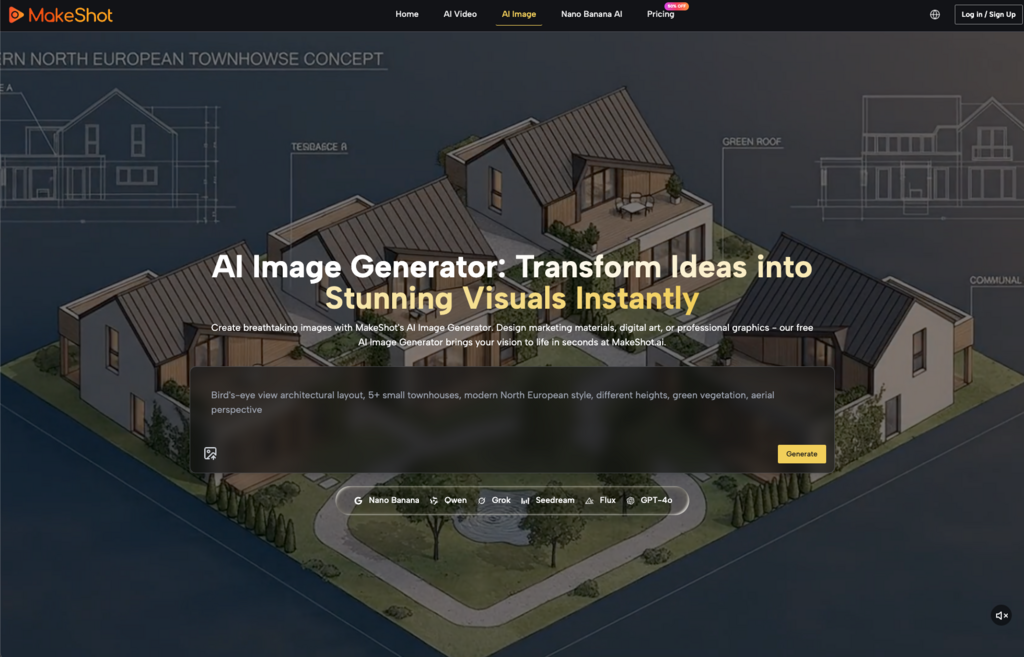
The challenge here is the friction of moving between different platforms, each with its own credit system, interface, and prompting logic. Platforms like MakeShot attempt to mitigate this by unifying access to these disparate engines. For an Ops Lead, having a single dashboard to test how different models handle the same prompt is a massive efficiency gain. It allows for “A/B testing” of the underlying technology before committing to a full production run. It is an acknowledgment that the AI Video Generator landscape is currently fragmented and that the best creative results come from a hybrid approach.
The post-generative ‘last mile’ for brand safety
Even the best generative outputs are rarely “camera-ready.” They often arrive at sub-standard resolutions or with low bitrates that won’t hold up on a 4K display or a large-scale digital billboard. The “last mile” of production is where the real work happens, and it is largely traditional.
First, there is the matter of upscaling and frame interpolation. Raw clips often feel slightly “dreamy” or blurry. Tools that use AI to add detail and smooth out the frame rate are essential for making the content look like it was shot on a professional sensor. Second is the role of color grading. If you are using multiple models, the color science will be inconsistent. A professional colorist (or a standardized LUT) must be applied across the entire sequence to “glue” the shots together visually.
There is also the matter of brand safety. If a generative model accidentally places a distorted version of a competitor’s logo in the background, or if the “physics” of a product shot look unappealing, the asset is unusable. In these cases, manual mask-and-replace in software like After Effects is still significantly faster and more reliable than re-rolling a prompt 100 times. We have to be honest: AI is currently an asset *generator*, not an asset *finisher*.

Limits of the technology: What cannot be solved yet
It is important to reset expectations regarding what these tools can actually do in a commercial setting. Despite the rapid progress, there are several “no-go zones” where generative video still fails consistently:
- Complex Physical Interaction: If a prompt involves a character picking up a transparent glass of water, drinking, and setting it back down, the physics usually break. The glass might merge with the hand, or the water might behave like a solid. This is a fundamental limitation of how models currently understand spatial relationships.
- Text and Branding: While image generators have improved with text, video generators still struggle to keep text stable on a moving object. A logo on a t-shirt will often warp, slide, or change spelling as the character moves.
- Extended Narrative Continuity: We are still quite far from a “one-click” movie. Maintaining a single character’s identity across 50 different shots in varying environments still requires a level of manual oversight and technical “hacking” that prevents full automation.
For high-stakes, litigious brand environments, these risks are often too high to allow for fully automated pipelines. There is a persistent need for human “sanity checks” at every stage of the generation.
Transitioning from generative curiosity to creative infrastructure
For those leading creative teams, the path forward isn’t about finding the “best” prompt. It’s about building an infrastructure that treats generative models as one part of a sophisticated toolchain. This means building internal libraries of “proven seeds”—specific combinations of reference images, model settings, and prompts that are known to produce consistent results for a specific brand look.
We are moving away from a world where AI is the “creator” and toward one where AI is a highly sophisticated asset engine controlled by human directors and editors. The speed of generation is impressive, but the value lies in the control. By focusing on I2V workflows, multi-model modularity, and traditional post-production finishing, teams can finally start to close the consistency gap and move generative video from a social media novelty to a core component of the marketing mix.
The goal is to stop treating the process like a lottery and start treating it like a factory. It’s less exciting than the “magic” narrative, but it’s the only way to make the technology usable for a brand that demands perfection.
