
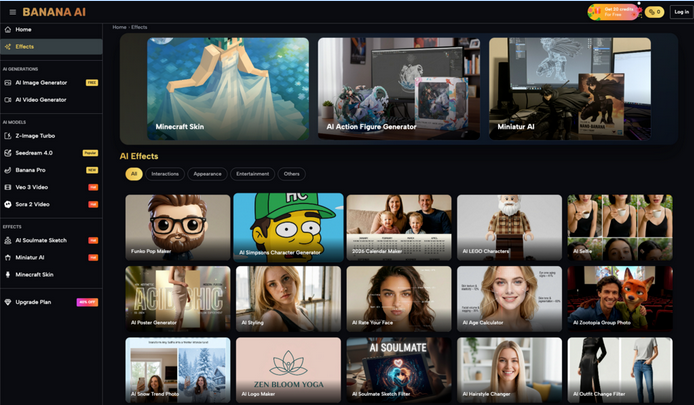
The current landscape of digital content production is defined by a paradox: we have more powerful creative tools than ever before, yet the actual process of moving a project from concept to published asset often feels slower and more fragmented. For professional content teams, the initial “wow” factor of generative AI has largely faded, replaced by the sober reality of managing creative operations. The “death by a thousand tabs” is a genuine productivity killer where creators bounce between a prompt-based image generator, a separate upscaling tool, a different platform for video synthesis, and a legacy editor for final touches.
When teams operate across these disparate silos, they lose more than just time. They lose the connective tissue of their creative vision. Every export and import cycle introduces friction, version control issues, and the risk of stylistic drift. The challenge for 2025 and 2026 isn’t just finding a tool that can generate a pretty picture; it is about building a unified media pipeline that bridges the gap between static generation and dynamic motion without the overhead of a fragmented tech stack.
The Hidden Cost of Media Tool Fragmentation
In a high-output environment, efficiency is rarely about how fast a single model can “think.” It is about how long it takes to move a file through the production gauntlet. When a design team uses one specialized platform for text-to-image and another for video, they are effectively paying a “context-switching tax.”
This tax manifests in several ways. First, there is the technical hurdle of file format compatibility and resolution mismatches. An image generated in one ecosystem might require significant pre-processing before it is compatible with another platform’s video-to-video or image-to-video model. Secondly, there is the cognitive load of managing multiple subscription tiers and credit systems.
Furthermore, the lack of a centralized dashboard prevents the development of a shared asset library. In a unified environment, an image created in the morning can be instantly upscaled, modified via image-to-image workflows, and converted into a social-ready video snippet by the afternoon—all within the same interface. This continuity is essential for reducing “creative decay,” the phenomenon where the quality or intent of a project diminishes every time it is forced through a different, non-integrated processing tool.
From One-Off Prompts to Scalable Visual Systems
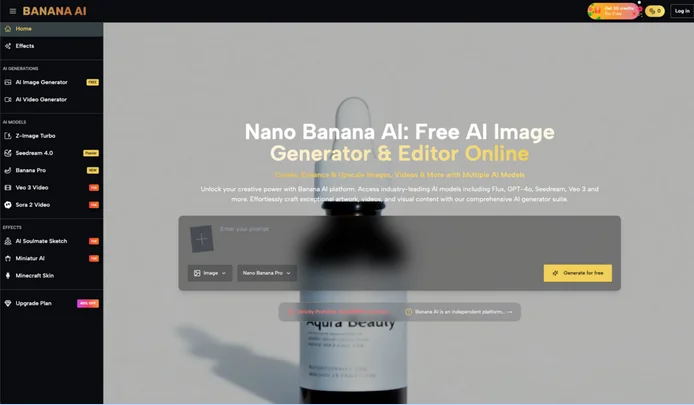
The transition from experimentation to professional publishing requires a shift in how we view the generation process. It is no longer about the single “perfect prompt” but about creating a repeatable visual system. This is where a centralized platform like Banana AI Image becomes a tactical asset rather than just a novelty. By consolidating different underlying models into one workflow, teams can maintain a baseline visual language across an entire campaign.
Establishing Stylistic Continuity
In a professional setting, a creator might use the Seedream 4.0 model for its specific artistic depth to establish the “hero” look of a brand launch. Using the image-to-image capabilities within the same ecosystem allows the creator to use that initial hero asset as a structural or stylistic anchor for subsequent generations. This ensures that the social media graphics, blog headers, and ad banners all feel like they belong to the same universe.
Human-led prompt engineering and manual refinement remain essential. While the AI provides the “accelerated draft,” the creative lead must still steer the model to avoid the “model-generic” aesthetic—that overly smoothed, hyper-saturated look that often signals low-effort AI content.
The Efficiency of Multi-Model Access
The value of a unified platform lies in the ability to switch models based on the specific requirements of a task. For example, a team might use a high-speed “Turbo” model for rapid-fire ideation and mood boarding during a client meeting. Managing this transition in one place—without needing to re-upload files or learn a new UI—cuts the production time for a visual series from days to hours.
Closing the Motion Gap: Integrating Video into the Feed
The most significant friction point in modern media workflows is the jump from static imagery to motion. Traditionally, this required a specialized video editor or a separate AI video subscription. However, the maturation of tools like Banana AI has allowed for a much tighter integration between the two mediums.
The Role of Image-to-Video Pipelines
For a content team, the most practical use case for AI video isn’t necessarily creating a feature film from scratch. It is about extending the life of static assets.
This process leverages the existing composition of the image, which significantly reduces the unpredictability often found in text-to-video generation. When the AI has a visual reference to start from, the resulting motion is more likely to respect the lighting, color palette, and subject matter of the original brand asset.
Navigating Technical Trade-offs
It is important to be analytical about the current state of video generation. While models like Veo 3 represent a massive leap forward, we must acknowledge the “uncertainty principle” in temporal consistency. Despite the high-resolution outputs now available, maintaining perfect consistency across long-form sequences—where a character’s face or a background’s architecture stays exactly the same for thirty seconds—is not yet a fully solved problem in the industry.
Creators should treat AI video as a tool for “social-ready snippets” rather than a total replacement for traditional stock footage or high-end cinematography in every scenario. The current sweet spot for generative video is in short-form engagement, where the motion acts as a visual hook rather than a long-form narrative vehicle.

Technical Guardrails: When Generative AI Reaches Its Limit
A tool-savvy creator knows that the most important part of a workflow is knowing when to step in. Even with the advanced capabilities of the Banana AI Image generator, there are moments of limitation. Anatomical details, specifically hands and eyes in complex poses, or highly specific architectural lettering, can still occasionally glitch.
In a professional publishing pipeline, the AI output should be viewed as a 90% solution. The final 10%—the retouching, the color grading to match a specific brand’s Hex codes, and the final check for spatial logic—must remain a human-driven process. The goal isn’t to remove the designer from the equation, but to remove the “grunt work” of building the initial scene, allowing the designer to focus exclusively on the high-value polish.
Furthermore, there is a visible caution regarding architectural precision. If a creator is generating an image for a real estate project or a technical manual, current generative models may struggle with structural integrity (e.g., stairs that lead nowhere or windows with impossible geometry). This is where the practical judgment of the operator is vital. Use the AI to generate the atmosphere and the lighting, but be prepared to use traditional masking and editing for the elements that require 100% factual accuracy.
Optimizing Creative Operations for the 2026 Landscape
As we move deeper into a “generative-first” media landscape, the winner won’t be the team with the most subscriptions, but the team with the most integrated pipeline. Transitioning from a tool-first mindset to a pipeline-first mindset means centralizing your production on platforms that offer multi-model flexibility.
The ROI of this consolidation is clear. Instead of paying for a niche portrait tool, a niche landscape tool, and a niche video tool, teams can utilize a consolidated credit system on a platform like Banana AI.
In conclusion, the maturation of the AI media market is signaled by the move away from isolated playgrounds toward professional-grade hubs. By understanding the limitations of the technology and leveraging the efficiencies of an integrated workflow, content teams can move beyond the “AI as a toy” phase and enter an era of sustainable, high-velocity publishing. The value lies in the transition—from image to video, from prompt to asset, and from idea to publication—handled within a single, coherent ecosystem.
