
There’s a specific kind of frustration that creative people know well: you can hear the music in your head — the mood, the tempo, even the way the chorus should land — but the moment you sit down to make it, the gap between imagination and execution swallows the whole thing.
You’re not a bad creator. You’re just missing a bridge.
For most of human history, that bridge was years of practice, an expensive studio, or a friend who happened to play guitar. But over the past two years, that gap has quietly closed. Not through better tutorials or cheaper instruments — through AI music generation that actually works.
Why the Old Barriers Don’t Hold Anymore
Learning to produce music traditionally means learning at least two separate crafts at once: musical theory (how chords, scales, and rhythm actually work) and production technique (how to make a recording sound professional instead of like a voice memo). Most people give up long before they’re good at either.
Even those who hire composers run into a different wall: cost, communication, and revision cycles. A short game soundtrack that fits the mood of your indie project might take weeks of back-and-forth and a four-figure budget.
AI changes this equation entirely. Modern AI music tools are trained on enormous libraries of real music — pop, jazz, orchestral, electronic, hip-hop, and dozens of hybrids — and they understand not just genre labels but the emotional texture of music. The difference between “sad piano music” and “melancholic, late-night piano with soft strings” is something today’s models actually parse and act on.
The result: you describe what you want in plain language, and you get a complete, production-ready track back in roughly the same time it takes to make coffee.
What “Production-Ready” Actually Means Here
This is worth dwelling on, because “AI music” used to mean something thin and mechanical — obvious loops, no dynamics, the kind of thing that immediately signals “placeholder audio.”
That’s no longer the benchmark. A serious ai music generator today outputs tracks with:
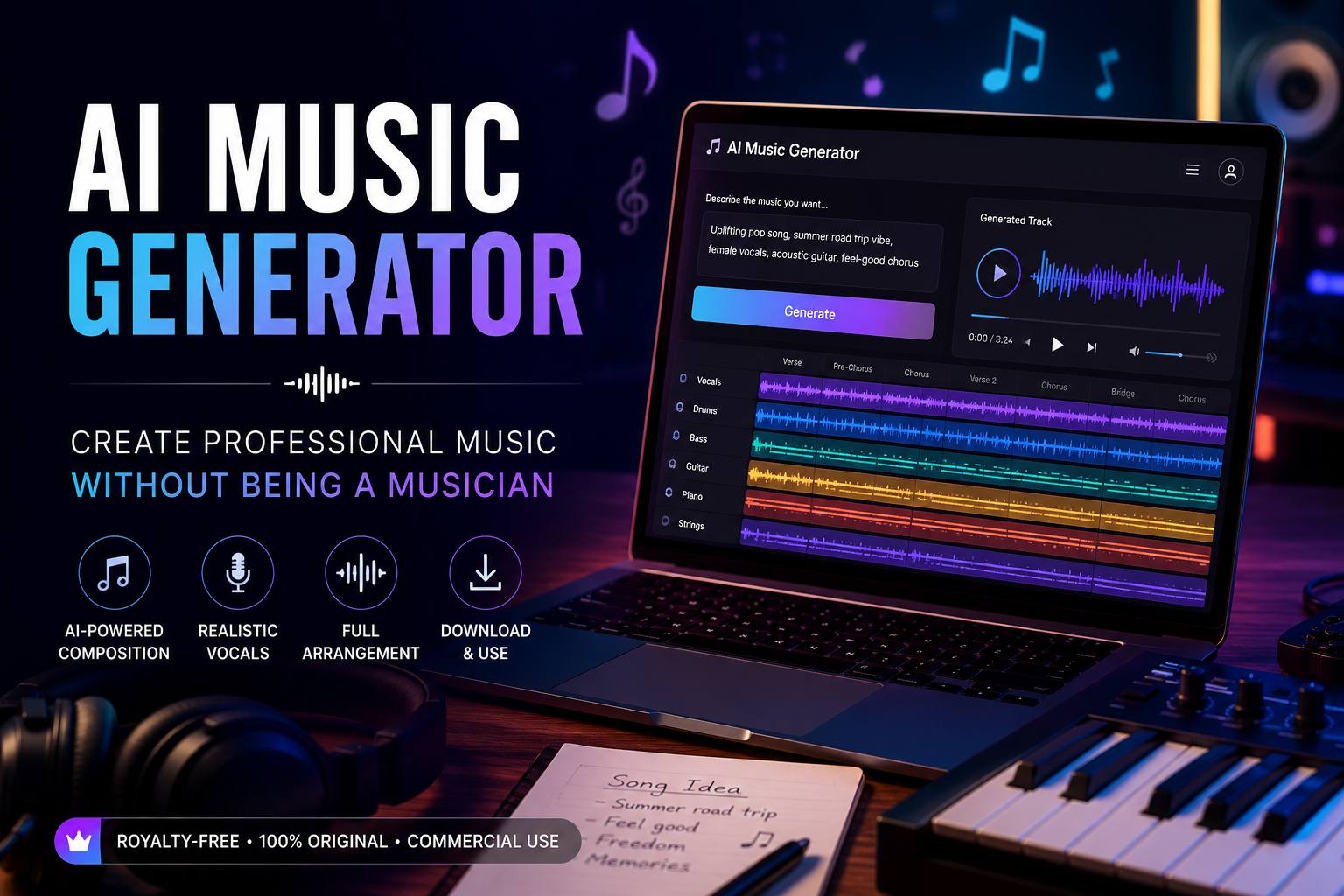
- Full arrangement — melody, chords, bassline, drums, and mixing all handled in a single generation
- Realistic vocals — you can choose male or female voice, or let the system decide what fits the mood
- Proper song structure — verse, pre-chorus, chorus, bridge — not just four bars on repeat
- Professional mastering — levels, compression, and EQ that make the track immediately usable
When someone asks whether AI-generated music “sounds real,” the honest answer is: most listeners cannot tell. The songs have emotional arc. They breathe. They have the kind of subtle variation that separates music from noise.
A Practical Workflow, Step by Step
Here’s how a creator — a YouTuber, a songwriter with lyrics but no melody, a game developer who needs an ambient track — actually uses this in practice.
Step 1: Describe with specificity, not genre labels alone
The most common beginner mistake is typing “hip-hop song” and hoping for the best. The model has everything it needs to make something generic. Feed it texture instead.
Compare:
- Weak prompt: “upbeat pop song”
- Stronger prompt: “upbeat pop song, summer road trip feeling, female vocals, bright acoustic guitar, moderate tempo, like a feel-good outro for a YouTube vlog”
The second prompt doesn’t require music theory knowledge — it just requires you to describe what you’re actually picturing. Think in terms of emotion, setting, and use case, not technical parameters.
Step 2: If you have lyrics, use them
One genuinely useful feature that gets underused: you can paste in your own lyrics and have the AI build the music around them. The model reads the emotional content of the lines — a melancholic verse will get a different melodic treatment than a triumphant hook — and generates chords, melody, and arrangement that fit what you wrote.
This is particularly valuable for songwriters who write in notebooks but can’t play an instrument. Your words become the input; the AI writes the music.
Step 3: Try two or three variations before committing
Generation takes under two minutes, so there’s no reason to settle for the first result. Small changes to your prompt — swapping “melancholic” for “bittersweet,” adding “late-night” as a modifier, toggling instrumental mode on — produce meaningfully different tracks. Most users find something they want to use within two to three tries.
Step 4: Download and use it
Tracks come out as MP3 or WAV files. For users on paid plans, stem exports are available — separate files for vocals, drums, bass, and melody — which makes post-generation editing in GarageBand, FL Studio, or any DAW straightforward. You own what you generate; there are no watermarks, no usage restrictions baked into the file.
Who Is Actually Using This, and How
YouTube and TikTok creators — The most immediate use case. Royalty-free background music that won’t trigger a Content ID claim is genuinely hard to find. AI-generated tracks are 100% original, which means zero risk of a copyright strike on a monetized video.
Indie game developers — A solo developer building a game used to face a choice: no music, generic stock music, or an expensive contract composer. Now the same person can generate a battle theme, an ambient exploration track, and a menu screen jingle in a single afternoon. The tracks can be styled to match the game’s aesthetic exactly.
Songwriters and producers — Demo creation used to require access to instruments, recording equipment, and time. A songwriter with a new idea can now generate a demo in minutes, test whether the concept works, and share a listenable version with collaborators or labels before committing to full production.
Podcast producers and educators — Custom intro/outro music, episode-specific background scoring, transition cues — all generatable to match a show’s specific tone without paying licensing fees per use.
The One Thing to Get Right: Your Prompt
Most of the variation in output quality comes not from the tool but from the input. The underlying model is highly capable; the question is whether you’re giving it something to work with.
A few principles that consistently improve results:
- Name the use case — “for a game boss fight,” “for a YouTube travel vlog,” “for a meditation app” — gives the model context that genre labels can’t.
- Include emotional adjectives — “tense,” “nostalgic,” “triumphant,” “eerily calm” — these translate into real musical decisions around tempo, key, dynamics, and instrumentation.
- Specify what you don’t want — Most tools let you exclude sounds or styles. If you know you don’t want heavy drums or distorted guitar, saying so is faster than regenerating.
- Don’t over-constrain too early — Leave room for the AI to make interesting choices. A prompt that dictates every instrument and tempo often produces something stiff. Describe the feeling; let the model decide some of the execution.
On Copyright and Commercial Use
For anyone publishing content online, this is the practical question that matters most. AI-generated music is original by definition — it doesn’t reproduce any existing recording. That means no Content ID matches on YouTube, no flagging on Twitch, no strikes on TikTok.
For commercial use — selling the music directly, using it in paid advertisements, or including it in client deliverables — most platforms require a paid plan that includes an explicit commercial license. This is worth checking per platform, but the general answer is yes, these tracks can be used commercially under the right subscription tier.
The Actual Shift Happening Here
What’s changing isn’t just that music is easier to make. It’s that the creative bottleneck has moved.
Music used to be bottlenecked by access: access to instruments, training, studios, collaborators. Now it’s bottlenecked only by imagination and clarity of vision. If you can describe what you’re hearing in your head with enough specificity, you can hear it back as a finished track within minutes.
That’s a genuine change in who gets to make music — not as a hobbyist approximation of the real thing, but as something you’d actually put in a real project. The creators who are figuring this out now have a meaningful advantage over those who haven’t started yet.
The bridge was always the hard part. It just got a lot shorter.
