
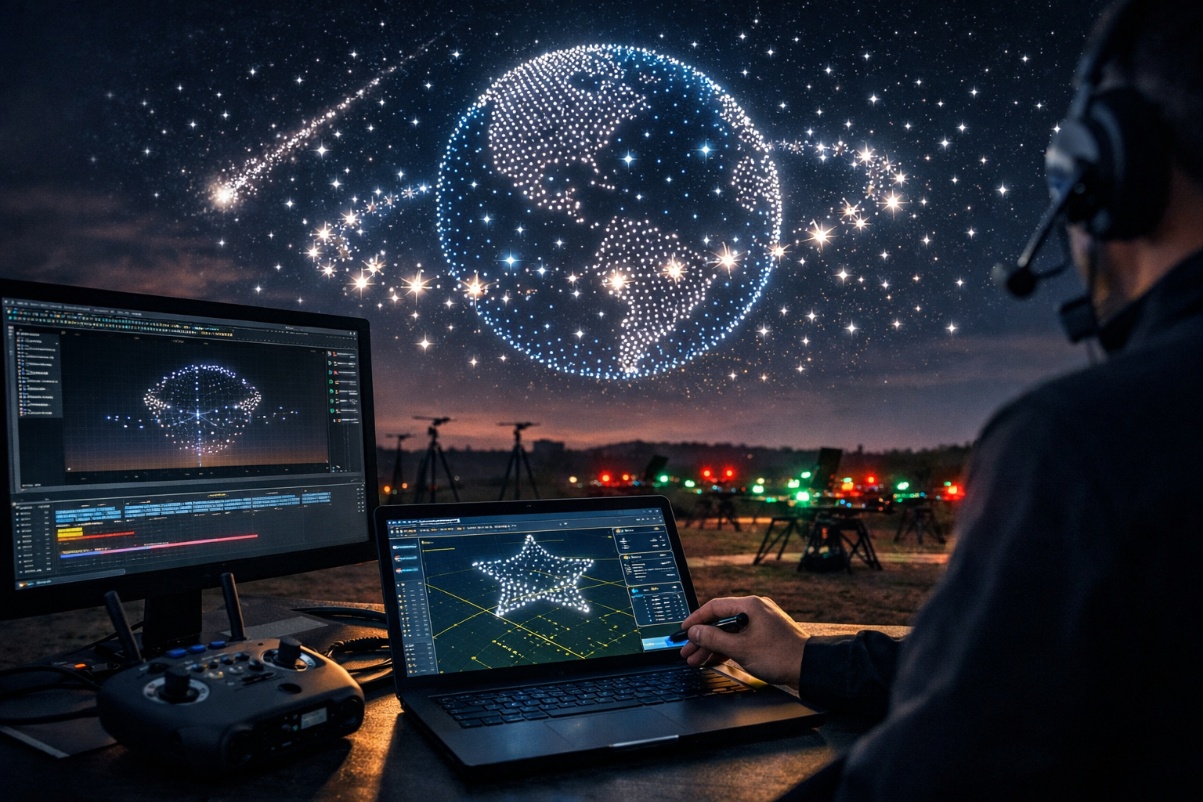
If you’ve ever watched hundreds of glowing drones paint shapes across the night sky, your first question was probably the same as everyone else’s: are drone shows actually programmed, or is someone manually piloting all of those aircraft? The short answer is yes — drone shows are entirely programmed — but the full picture is far more fascinating than a simple yes or no.
Working with a professional aerial drone light show company is the clearest way to understand just how deep the technology goes. From initial concept to the final synchronized performance, every second of a drone show is the result of meticulous digital engineering, artistic design, and rigorous safety protocols.
What Does “Programming a Drone Show” Actually Mean?
Programming a drone show is nothing like writing code for a website or an app. It is a multi-disciplinary process that combines 3D animation, aerospace engineering, and real-time computing.
The process starts with a creative brief. The show designers define what shapes, logos, animations, or narratives the drones will form in the sky. These visuals are then modeled in specialized 3D software that converts each frame of the animation into precise GPS waypoints — individual coordinates in three-dimensional space that each drone must reach at a specific moment in time.
Each drone in the fleet is assigned its own unique flight path. A show featuring 200 drones means 200 individual flight programs running simultaneously, each calculated to avoid collisions, maintain safe separation distances, and arrive at the right position at exactly the right millisecond. This is known as trajectory optimization, and it is one of the most computationally demanding parts of the entire workflow.
The Software Behind the Magic
Modern drone shows rely on proprietary software platforms developed by show operators themselves or purchased from specialized technology vendors. These platforms handle several critical functions at once.
Collision avoidance algorithms are at the core of every drone show software. Before a single aircraft leaves the ground, the system runs thousands of simulations to verify that no two drones will ever occupy the same point in space at the same time. If a conflict is detected, the software automatically recalculates one or both flight paths.
Formation transitions are another key challenge. Moving from a star shape to a company logo to a waving flag involves every drone in the fleet simultaneously relocating to a new position. The software calculates the most efficient path for each drone while maintaining the visual integrity of both the outgoing and incoming formation.
Synchronization with audio adds another layer of complexity. When a drone show is set to music — as most professional performances are — every movement, color change, and formation shift must be timed to specific beats, phrases, or moments in the soundtrack. This is done by mapping the animation timeline to the audio waveform inside the show design platform.
From a Computer to the Sky: How the Program Is Executed
On the day of the performance, the pre-programmed flight data is uploaded to each drone in the fleet via a ground control system. Once the show begins, a central command computer broadcasts synchronized signals to every aircraft, ensuring they all launch, move, and transition in perfect unison.
The drones themselves are not navigating autonomously in the traditional sense. They are following pre-calculated routes, but their onboard sensors — GPS, barometric pressure sensors, accelerometers, and gyroscopes — are constantly feeding data back to onboard processors that make micro-adjustments to keep each aircraft precisely on its programmed trajectory, even in mild wind conditions.
Human operators remain on-site throughout the performance, monitoring the fleet in real time. If any drone deviates from its programmed path beyond an acceptable threshold, or if weather conditions deteriorate unexpectedly, operators can trigger an immediate and safe landing of the entire fleet. This failsafe mechanism, often called a kill switch, is a non-negotiable safety feature in professional operations.
How Long Does It Take to Program a Drone Show?
The programming timeline depends heavily on the complexity and length of the show, the number of drones involved, and the level of customization required.
A relatively straightforward show of 100 to 200 drones with two or three formation changes and a runtime of around 10 minutes might require two to four weeks of design and programming work. A large-scale production featuring 500 or more drones, complex narrative animations, and full audio synchronization can require two to three months of pre-production.
Regulatory preparation adds time to the equation as well. Most countries require drone show operators to file flight authorization requests with civil aviation authorities weeks in advance. In many European jurisdictions, public-facing shows require a minimum of 45 days’ notice.
Can Anything Go Wrong During a Programmed Show?
No live performance — no matter how well prepared — is entirely immune to the unexpected. Wind gusts, sudden temperature drops, radio frequency interference, and GPS signal degradation can all affect drone performance in the field.
Professional operators account for these risks at the programming stage by building in generous safety margins between aircraft, defining exclusion zones around the audience, and programming automatic return-to-home behaviors for any drone that loses communication with the ground station.
The result is that professionally produced drone shows have an extraordinarily strong safety record. The combination of rigorous pre-show simulation, redundant communication systems, and skilled human oversight makes them one of the safest forms of live aerial entertainment available today.
The Human Creativity Behind the Code
It would be a mistake to think of drone shows as purely technical exercises. The programming is the backbone, but the soul of every great show is the artistic vision that drives it.
Show designers spend considerable time crafting the narrative arc of a performance: which formations will appear and in what order, how transitions will feel emotionally, how the visuals will respond to the mood and tempo of the music. The best drone shows are not just impressive feats of engineering — they are genuinely moving experiences that leave audiences speechless.
Conclusion: Every Light in the Sky Has a Plan
So, are drone shows programmed? Absolutely — and the depth of that programming is what separates a forgettable spectacle from a genuinely unforgettable event. Every flight path, every color change, every perfectly timed formation is the result of weeks of design work, advanced software, and expert human oversight.
The next time you watch a fleet of drones trace a company logo or a soaring bird across the night sky, know that behind every light is a precisely calculated journey — planned down to the centimeter and the millisecond.
